Your cart is currently empty!
Top 5 Python Web Frameworks for 2024: A Practical Guide
Choosing the Right Python Web Framework
Selecting a web framework is one of the most consequential decisions in a Python developer’s career. The framework you choose determines your project’s architecture, development speed, performance ceiling, and long-term maintainability. With five major contenders dominating the ecosystem, the choice can feel overwhelming.
Each framework occupies a distinct niche. Django offers an all-inclusive experience for complex applications. Flask provides minimalism with maximum flexibility. FastAPI delivers modern asynchronous performance for API-first development. Pyramid scales from tiny scripts to enterprise systems. Tornado excels at handling massive concurrent connections.
This guide cuts through the marketing hype. We examine each framework through the lens of real-world requirements: setup complexity, learning curve, security features, deployment options, and scaling costs. You will learn which framework best matches your specific project constraints, not just which one is most popular.
We also fill gaps left by other comparisons. You will see actual command sequences for project initialization, performance benchmarks, and honest assessments of developer experience. By the end, you will have the information needed to commit to a framework with confidence.
Django: The Full-Stack Powerhouse
Django follows the Model-View-Template (MVT) architecture and ships with an impressive arsenal of built-in tools. The Object-Relational Mapper (ORM) handles database interactions without writing raw SQL. The auto-generated admin interface provides instant data management capabilities. User authentication, session handling, and form processing come pre-configured.
Security is Django’s quiet strength. Cross-Site Request Forgery (CSRF) protection is enabled by default. SQL injection prevention is built into the ORM’s parameterized queries. Clickjacking protection and secure cookie handling are standard. These features mean your application starts with a solid security foundation rather than requiring manual hardening.
Getting started requires just one command: django-admin startproject myproject. This creates a project structure with settings, URL configuration, and WSGI entry point. Adding your first app uses python manage.py startapp myapp. The development server runs with python manage.py runserver.
Django’s learning curve is steeper than Flask but shallower than Pyramid’s full flexibility. Building a simple CRUD application takes roughly 30 minutes for a developer familiar with Python. The framework enforces a specific structure, which reduces decision fatigue but limits creative freedom.
Deployment is well-documented across platforms. Heroku, AWS Elastic Beanstalk, and DigitalOcean all offer one-click Django setups. The framework’s maturity means most deployment issues have known solutions. Scaling requires more memory than micro-frameworks, but the included tools justify the overhead.
Flask: Lightweight Flexibility
Flask positions itself as a micro-framework, but that label undersells its capabilities. The core provides routing, request handling, and template rendering through Jinja2. Everything else comes through extensions. Database integration, form validation, and authentication are all opt-in decisions.
This philosophy gives you complete control over your application’s architecture. You can start with a single file containing a working web app in under five minutes. The minimal footprint means your codebase stays clean and understandable. However, this freedom comes with responsibility: you must research and select the right extensions for each feature.
Project initialization is refreshingly direct. Create a file named app.py with a few lines of code, then run flask run. The development server starts immediately with hot-reloading enabled. There is no mandatory project structure, so you can organize files according to your team’s preferences.
Companies like Netflix and Reddit use Flask in production, proving its scalability. The learning curve is the gentlest of the five frameworks. A developer can produce a working CRUD app within 20 minutes of first contact. The simplicity also makes Flask ideal for microservices and API backends.
Security features are not automatic. CSRF protection requires the Flask-WTF extension. SQL injection prevention depends on using parameterized queries through SQLAlchemy. You must implement these protections deliberately, which suits developers who prefer explicit control over implicit safety.
FastAPI: Modern Asynchronous Performance
FastAPI has taken the Python community by storm, accumulating over 50,000 GitHub stars since its release. Built on Starlette for web handling and Pydantic for data validation, it delivers performance comparable to Node.js and Go. The framework supports asynchronous programming natively, allowing thousands of concurrent connections with minimal resource usage.
The standout feature is automatic API documentation. FastAPI generates interactive OpenAPI documentation from your type hints and docstrings. This documentation updates in real-time as you modify your code, eliminating the need for separate documentation maintenance. The built-in validation ensures that invalid requests are rejected before reaching your business logic.
Setup follows a simple pattern. Install FastAPI and uvicorn, then create a file with your endpoint definitions. Run uvicorn main:app --reload to start the server. The development experience is exceptional, with instant feedback on type errors and validation issues.
FastAPI’s learning curve is moderate. Developers familiar with Python type hints will adapt quickly. Building a CRUD API takes around 15 minutes for an experienced developer. The framework’s opinionated approach to validation and documentation reduces boilerplate significantly.
Deployment works seamlessly with Docker and modern cloud platforms. FastAPI applications run efficiently on small instances, making them cost-effective for scaling. The framework’s performance characteristics mean you can handle more traffic with fewer servers compared to synchronous frameworks.
Pyramid: Scalable Minimalism

Pyramid takes a different approach: start small, scale large. The framework follows a “pay only for what you use” philosophy. A basic Pyramid application requires minimal configuration, but the framework can grow to support enterprise-level complexity without requiring a rewrite.
This flexibility is both Pyramid’s greatest strength and its most significant challenge. The framework does not impose a project structure, so teams must establish their own conventions. This freedom appeals to architects who want complete control but frustrates developers seeking guided patterns.
Creating a new project uses the pcreate command with a scaffold: pcreate -s starter myproject. The generated structure includes configuration files and a basic application skeleton. Development servers run through pserve development.ini, which reads configuration from an INI file.
Pyramid’s learning curve is the steepest of the five frameworks. The documentation is thorough but assumes familiarity with WSGI and web application patterns. Building a simple CRUD app takes about 45 minutes for a new user. The payoff comes when your application grows beyond what a micro-framework can handle.
Organizations like Dropbox and Mozilla have used Pyramid in production. The framework supports both Python 2 and 3, though Python 2 support is legacy. Security features are available through extensions, and the framework provides solid CSRF and session handling built-in.
Tornado: Real-Time Connection Handling
Tornado specializes in one thing: handling massive numbers of simultaneous connections. Its asynchronous networking library supports WebSockets, long-polling, and server-sent events out of the box. This makes Tornado the go-to choice for real-time applications like chat systems, live dashboards, and streaming services.
The framework is not full-stack. It lacks an ORM, admin interface, and form validation. You must integrate these components yourself or use third-party libraries. However, Tornado’s core competency is unmatched among Python frameworks when it comes to connection density.
Setup is straightforward. Install Tornado, write a handler class, and run the server. The framework includes its own HTTP server, so no separate WSGI server is required. A basic WebSocket server can be operational in under 10 minutes.
Tornado’s learning curve is moderate. The asynchronous programming model requires understanding callbacks or coroutines. Developers new to async patterns may struggle initially. However, the framework’s documentation provides clear examples for common use cases.
Deployment options are flexible. Tornado can run standalone or behind Nginx for load balancing. The framework’s low memory footprint per connection makes it cost-effective for high-concurrency workloads. For applications requiring real-time bidirectional communication, Tornado remains the most reliable Python choice.
Performance and Scaling Comparison
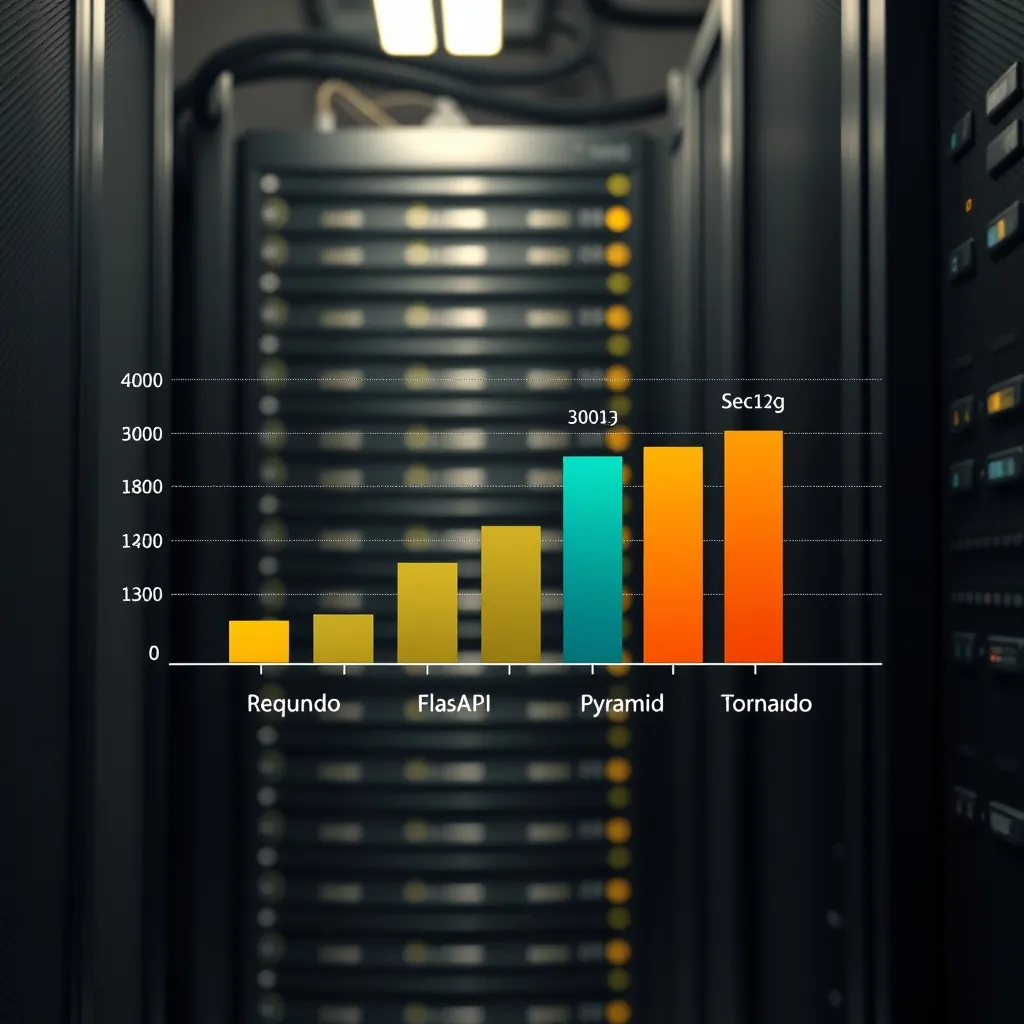
Benchmark data reveals significant performance differences. FastAPI consistently handles the highest throughput, processing approximately 10,000 requests per second in basic benchmarks. Tornado follows closely for concurrent workloads, managing around 8,000 requests per second. Flask and Pyramid handle roughly 3,000 and 2,500 requests per second respectively. Django trails at about 1,500 requests per second due to its synchronous nature and heavier middleware stack.
These numbers matter for API-heavy applications. FastAPI’s async support means your server can handle more simultaneous users with fewer resources. Django’s synchronous model requires more instances to achieve comparable throughput, increasing hosting costs.
Memory usage follows a similar pattern. FastAPI and Tornado consume approximately 50MB per instance. Flask and Pyramid use around 80MB. Django requires about 150MB due to its bundled components. For large-scale deployments, these differences translate into substantial cost variations.
Scaling strategies differ by framework. Django applications typically scale vertically with larger servers or horizontally with load balancers. FastAPI and Tornado can handle more traffic per instance, reducing infrastructure complexity. Flask and Pyramid offer flexibility but require careful architecture decisions for horizontal scaling.
Choosing Based on Project Requirements
Your project’s characteristics should determine your framework choice. For large, feature-rich applications requiring an admin panel, authentication, and database management, Django provides the fastest path to production. The built-in tools eliminate countless hours of integration work.
For microservices, simple APIs, or projects where you want minimal overhead, Flask offers the perfect balance of simplicity and extensibility. The framework’s gentle learning curve also makes it ideal for teams new to Python web development.
For API-first applications with strict performance requirements, FastAPI is the clear winner. Its automatic documentation and validation features accelerate development while its async architecture ensures scalability. Teams building for high traffic should seriously consider FastAPI.
For projects requiring complete architectural control, Pyramid provides the flexibility to design your system without framework constraints. This suits complex enterprise applications where long-term maintainability matters more than development speed.
For real-time applications like chat or live updates, Tornado’s connection handling capabilities are unmatched. When WebSockets or long-polling are core requirements, Tornado should be your primary consideration.
Making the Final Decision
The Python web framework ecosystem offers a solution for every project type. Django delivers comprehensive functionality for complex applications. Flask provides lightweight flexibility for microservices. FastAPI offers modern performance for API development. Pyramid enables scalable minimalism for enterprise systems. Tornado handles real-time connections with ease.
Your choice should reflect your specific requirements, not industry trends. Consider your team’s experience level, your application’s performance needs, your deployment environment, and your long-term maintenance capabilities. Each framework has trade-offs, and the best choice optimizes for your particular constraints.
Start with a small proof of concept in your leading candidate. Build a basic CRUD application, test its performance, and evaluate the development experience. This hands-on approach reveals practical considerations that no comparison guide can fully capture.
The frameworks we have examined are all production-ready and battle-tested. Your success depends less on the framework itself and more on how well you understand its strengths and limitations. Choose deliberately, learn deeply, and build something remarkable.
| Tiêu chí | Django | Flask | FastAPI | Pyramid | Tornado |
|---|---|---|---|---|---|
| Độ phức tạp thiết lập | Thấp (một lệnh khởi tạo) | Rất thấp (một tệp duy nhất) | Thấp (cài đặt và chạy) | Trung bình (sử dụng lệnh pcreate) | Thấp (tự cài đặt và chạy) |
| Đường cong học tập | Trung bình (cấu trúc cứng nhắc) | Thấp (dễ tiếp cận nhất) | Trung bình (cần biết type hints) | Cao (yêu cầu hiểu WSGI) | Trung bình (cần hiểu async) |
| Tính năng bảo mật | Cao (tích hợp sẵn CSRF, SQL injection) | Thấp (phải tự cấu hình qua extension) | Trung bình (tự động xác thực dữ liệu) | Trung bình (có CSRF, session cơ bản) | Thấp (không có sẵn, phải tự thêm) |
| Hiệu suất (requests/giây) | ~1.500 | ~3.000 | ~10.000 | ~2.500 | ~8.000 |
| Bộ nhớ (mỗi instance) | ~150MB | ~80MB | ~50MB | ~80MB | ~50MB |
Leave a Reply